


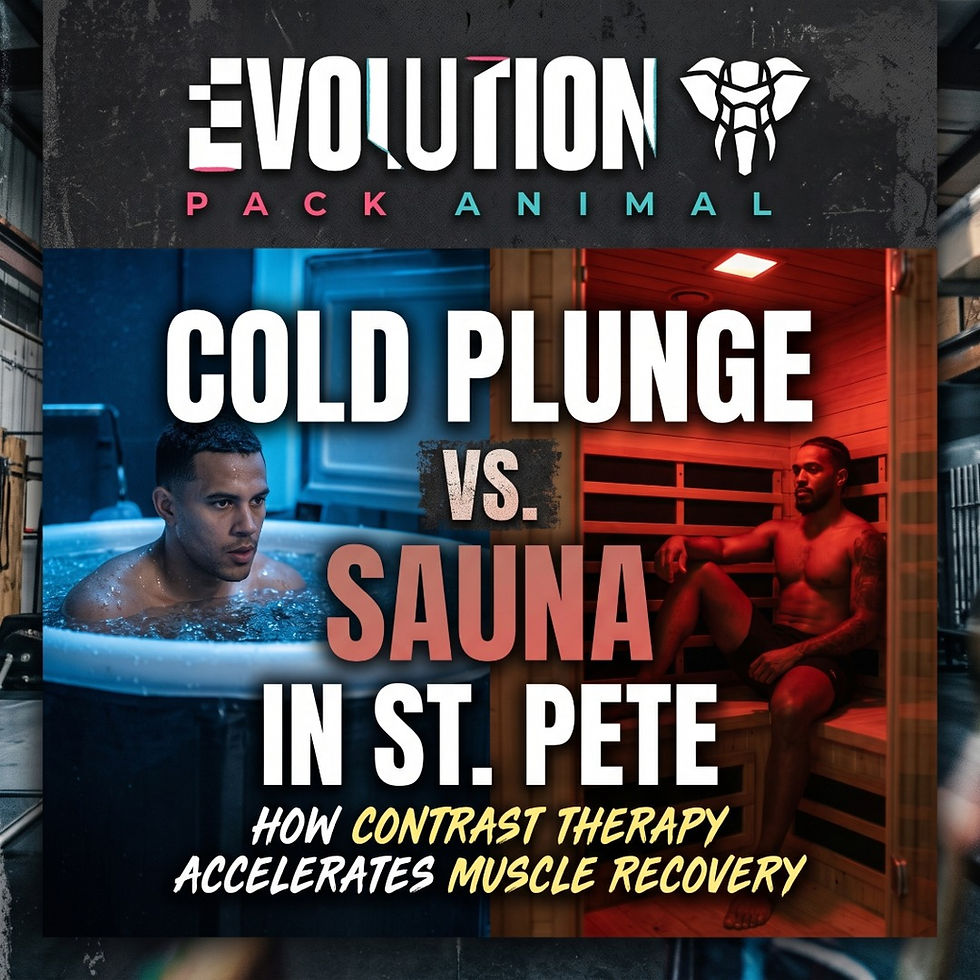
Cold Plunge vs. Sauna in St. Pete: How Contrast Therapy Accelerates Muscle Recovery and Performance
Finding a space dedicated to serious strength training is rare enough. Finding one that pairs competition-grade iron with an integrated wellness suite is practically unheard of.
For years, dedicated lifters and athletes across Pinellas County have faced an inconvenient trade-off: push heavy weights in a warehouse gym, then drive across town and pay boutique spa day rates just to access recovery modalities like cold water immersion and heat therapy.
Contrast therapy—the deliberate alternation between extreme heat and cold water immersion—has shifted from an elite athletic secret into a cornerstone of modern athletic recovery. At Pack Animal Fitness in St. Petersburg, Florida, that recovery loop is built directly into the facility.
Here is how contrast therapy works, how to properly balance the cold plunge and infrared sauna, and how to program recovery sessions around intense lifts.
The Physiology of Contrast Therapy: The Vascular "Pump"
Contrast therapy relies on a rapid circulatory reaction driven by temperature extremes:
Vasodilation (The Heat Phase): When sitting in an infrared or traditional dry sauna, core body temperature rises. Blood vessels dilate (expand), drawing blood toward the skin and increasing heart rate to a gentle cardiovascular cadence. This heat encourages cellular repair by activating heat shock proteins and easing soft-tissue tightness.
Vasoconstriction (The Cold Phase): Stepping into a cold plunge tub triggers an immediate survival reflex. Blood vessels rapidly constrict, shunting blood from extremities directly toward vital core organs. This rapid flush reduces peripheral swelling and blunts acute joint inflammation.
The Alternating Flush: Repeating this cycle 2 to 3 times functions like a biological pump. The mechanical action accelerates the clearance of metabolic waste (such as lactate and excess hydrogen ions) while driving oxygen-rich, nutrient-dense blood straight back into fatigued muscle fibers.
Clinical recovery research, including systematic reviews published in the National Library of Medicine (PubMed), consistently demonstrates that active contrast water therapy reduces Delayed Onset Muscle Soreness (DOMS) and accelerates perceived recovery far more effectively than passive rest alone.
Cold Plunge vs. Infrared Sauna: When to Use Which?
Both modalities provide targeted benefits, but their application depends on training goals and timing:
Feature / Modality | Infrared & Traditional Sauna | Cold Plunge Tub |
Primary Mechanism | Vasodilation, thermal stress, sweat flush | Vasoconstriction, cold shock response |
Core Physiological Benefit | Stimulates heat shock proteins, eases joint rigidity, enhances cardiac stroke volume | Blunts inflammation, surges norepinephrine, triggers mental alertness |
Best Used For | Pre-workout mobility, deload sessions, evening relaxation | Acute soreness relief, off-day recovery, neurological reset |
Hypertrophy Consideration | Safe immediately post-workout without dampening muscle growth signals | Should be delayed 3–4+ hours after heavy hypertrophy/strength lifts |
The Hypertrophy Rule: Don't Blunt Your Gains
While cold immersion is unmatched for rapid joint and central nervous system (CNS) reset, peer-reviewed sports science reveals that freezing cold water immediately post-lift blunts anabolic inflammatory signaling pathways (such as mTOR) needed for muscle protein synthesis.
For pure muscle growth: Perform cold immersion on dedicated rest days, or wait at least 3 to 4 hours post-lifting.
For athletic output and rapid turnaround: If prepping for a competition or completing multi-session daily performance training, immediate cold immersion keeps muscles loose and functional for subsequent work.
Step-by-Step Contrast Protocol for Athletes
A standard, evidence-based contrast session takes roughly 35 to 45 minutes:
Hydrate: Drink 16–24 oz of water with electrolytes prior to beginning.
Heat (Round 1): Spend 10–15 minutes in the sauna to raise core body temperature and relax resting muscle tension.
Cold (Round 1): Transition immediately into the cold plunge (typically set between 48°F and 55°F) for 1 to 3 minutes. Focus on slow, diaphragmatic breathing through the nose to calm the sympathetic nervous system.
Repeat (Rounds 2 & 3): Return to the sauna for 10–12 minutes, followed by 1–2 minutes back in the plunge.
Decide How to Finish:
End on Cold: If hitting a daytime session or looking for high mental clarity and focus, finish in the cold plunge to keep blood vessels constricted and norepinephrine elevated.
End on Heat: If recovering in the evening, end in the sauna to promote muscle relaxation and prepare the body for deep sleep.
The Hardcore Training & Recovery Advantage in St. Pete
Most commercial gym chains only offer standard cable machines and low-heat recreational saunas. Meanwhile, specialized recovery lounges rarely cater to lifters who want to train heavy.
Pack Animal Fitness was engineered to bridge that exact divide. By pairing an 11,000-square-foot warehouse gym—outfitted with specialty powerlifting racks, bodybuilding machinery, 700+ square feet of turf, and a private posing check-in room—with an on-site recovery suite featuring cold plunges and infrared saunas, athletes can address physical development and biological repair under one roof.
Whether recovering from high-volume sled pushes or working through a contest prep cycle, access to targeted recovery speeds up regeneration times and decreases injury risk.
Frequently Asked Questions (Q & A)
Q: How often should I use contrast therapy?
A: Most athletes see peak results by incorporating contrast therapy 2 to 3 times per week. This can be executed on non-lifting recovery days or several hours after heavy strength training.
Q: Can I use the cold plunge right after a heavy squat or bench session?
A: If the goal is maximum muscle hypertrophy (size), wait at least 3 to 4 hours before cold plunging. Immediate cold immersion suppresses natural inflammation necessary for tissue remodeling. However, the sauna can be used right after a workout safely.
Q: How cold is the cold plunge at Pack Animal Fitness?
A: Cold plunge tubs generally operate between 45°F and 55°F. This range provides optimal vasoconstriction and autonomic nervous stimulation without requiring freezing temperatures that can cause excessive physical shock.
Q: Do I need to be a full-time member to use the recovery amenities?
A: Day passes and multi-class recovery packages are available, alongside all-inclusive 24/7 memberships that bundle unlimited recovery suite access with 24-hour gym privileges.
External Resources & Further Reading
Learn more about Pack Animal Fitness memberships and amenities.
Review scientific literature on cold water immersion at the National Center for Biotechnology Information (NCBI).
Explore local training updates on the Pack Animal Fitness Performance Blog.


